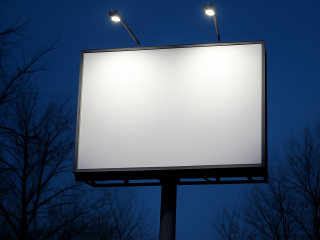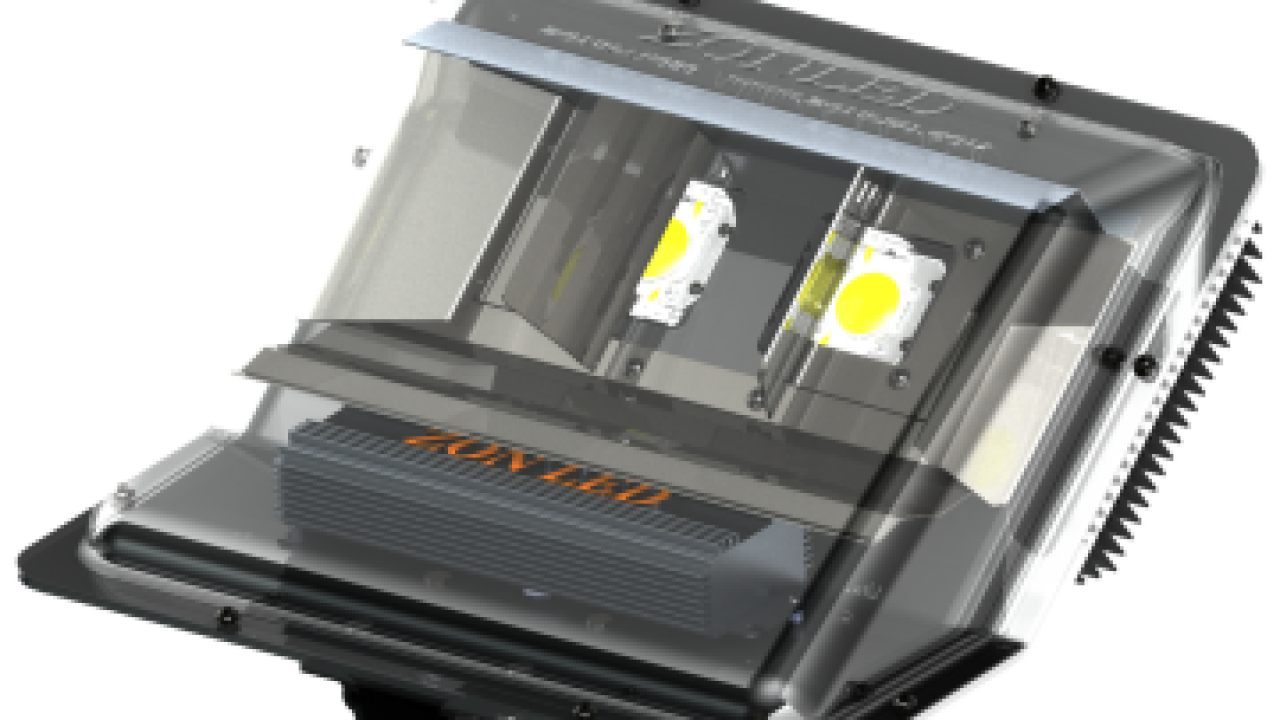
The Raptor 130 is a billboard light fixture built around a planar LED array. It produces 23,160 lumens at a maximum power consumption of 130 watts — the point of the design being that a sign face can be lit to the same perceived brightness while the connected load drops sharply.
Rated lamp life reaches 50,000 hours, which at twelve hours a night, seven nights a week works out at about ten years of service. For billboard lighting that figure matters as much as the energy number: every relamping means a lift, a crew and a road closure, so the maintenance interval is often the larger part of the cost of keeping a sign lit.
A further point specific to signage is retrofit: the fixture family includes signage retrofit units, so an existing arm and mount can be reused rather than rebuilt.
What distinguishes the fixtures
- Long service life. Rated lamp life reaches up to 100,000 hours, with roughly 50,000 hours of continuous operation taken as the working figure. Passive cooling means no fans and no moving parts to fail.
- Consistent output. There is no appreciable decline in output across the life of the diode, whereas many HID sources lose 60% or more of their initial output before they are replaced.
- Lower energy use. In a correctly matched replacement, energy use falls by up to 75% against HID and about 50% against fluorescent lighting. The fixtures also run cooler, which reduces the cooling load of the building they sit in.
- Light quality. Colour temperature around 5,000 K places the output close to the daylight spectrum, with no ultraviolet component.
- Scotopically enhanced. Because scotopic output describes perceived brightness better than photopic lumens, a lower-wattage LED fixture can stand in for a far higher photopic-lumen source.
- Safe, rugged, quiet. Low-voltage operation, no mercury or lead, no filament to break and no envelope to burst. The fixtures tolerate heat, cold and shock, and produce no flicker, no buzz and no infrared or ultraviolet radiation.
- Environmental profile. No hazardous materials in manufacture, and large reductions in greenhouse gas emissions per fixture replaced.