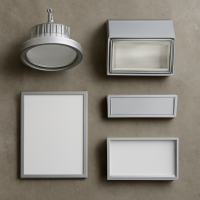
Zon Led is a Michigan-built range of LED luminaires designed for the places where discharge lighting used to be the only option: billboards, high interiors, loading areas, car parks, fuel-station canopies and ceiling grids. The common idea across the range is a planar LED array driven well below its limit, cooled passively, and packaged in a housing that fits the mounting already on site.
Fixture families
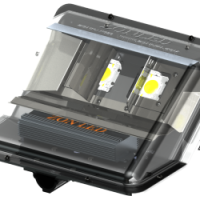
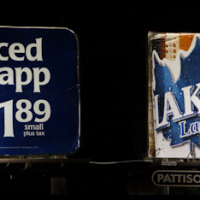
- Billboard fixtures — asymmetric throw for signage faces, the Raptor 130 being the best known of them.
- Lowbay tasklight fixtures — for ceilings low enough that glare control matters more than raw output.
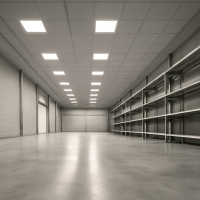
- Highbay down light fixtures — direct distribution for warehouses, workshops and halls.
- Ninja highbay indirect fixtures — indirect distribution for the same heights, where a softer ceiling-washed light is wanted.
- Lightning wallpack fixtures — wall-mounted units in 25, 50, 80 and 100 W sizes, with an optional motion and dimming sensor.
- Lightning parking lot fixtures — pole-mounted area lighting.
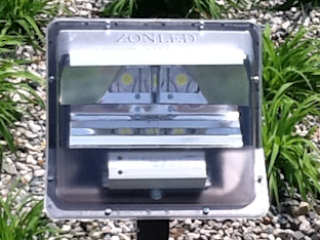
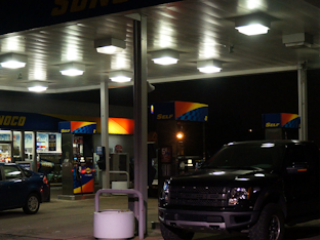
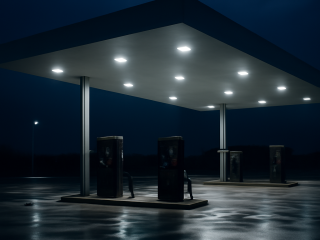
- Gas station canopy fixtures — the recessed Zon Focus Canopy 100, plus retrofit units: Elsco Retrofit 80 and 100, and 24-inch round retrofits in 80 and 100 W.
- Lay-in troffer fixtures — 2×2 and 2×4 units for T-bar ceilings, alongside a fluorescent troffer retrofit.
- Other units — recessed can downlights from 12 to 26 W, an 85 W Acorn street light, a Titanium line and a 50 W solar street light.
What distinguishes the fixtures
- Long service life. Rated lamp life reaches up to 100,000 hours, with roughly 50,000 hours of continuous operation taken as the working figure. Passive cooling means no fans and no moving parts to fail.
- Consistent output. There is no appreciable decline in output across the life of the diode, whereas many HID sources lose 60% or more of their initial output before they are replaced.
- Lower energy use. In a correctly matched replacement, energy use falls by up to 75% against HID and about 50% against fluorescent lighting. The fixtures also run cooler, which reduces the cooling load of the building they sit in.
- Light quality. Colour temperature around 5,000 K places the output close to the daylight spectrum, with no ultraviolet component.
- Scotopically enhanced. Because scotopic output describes perceived brightness better than photopic lumens, a lower-wattage LED fixture can stand in for a far higher photopic-lumen source.
- Safe, rugged, quiet. Low-voltage operation, no mercury or lead, no filament to break and no envelope to burst. The fixtures tolerate heat, cold and shock, and produce no flicker, no buzz and no infrared or ultraviolet radiation.
- Environmental profile. No hazardous materials in manufacture, and large reductions in greenhouse gas emissions per fixture replaced.
Separate pages cover the physics of LED light, the difference between scotopic and photopic measurement, and the environmental arithmetic of replacing a discharge fixture.