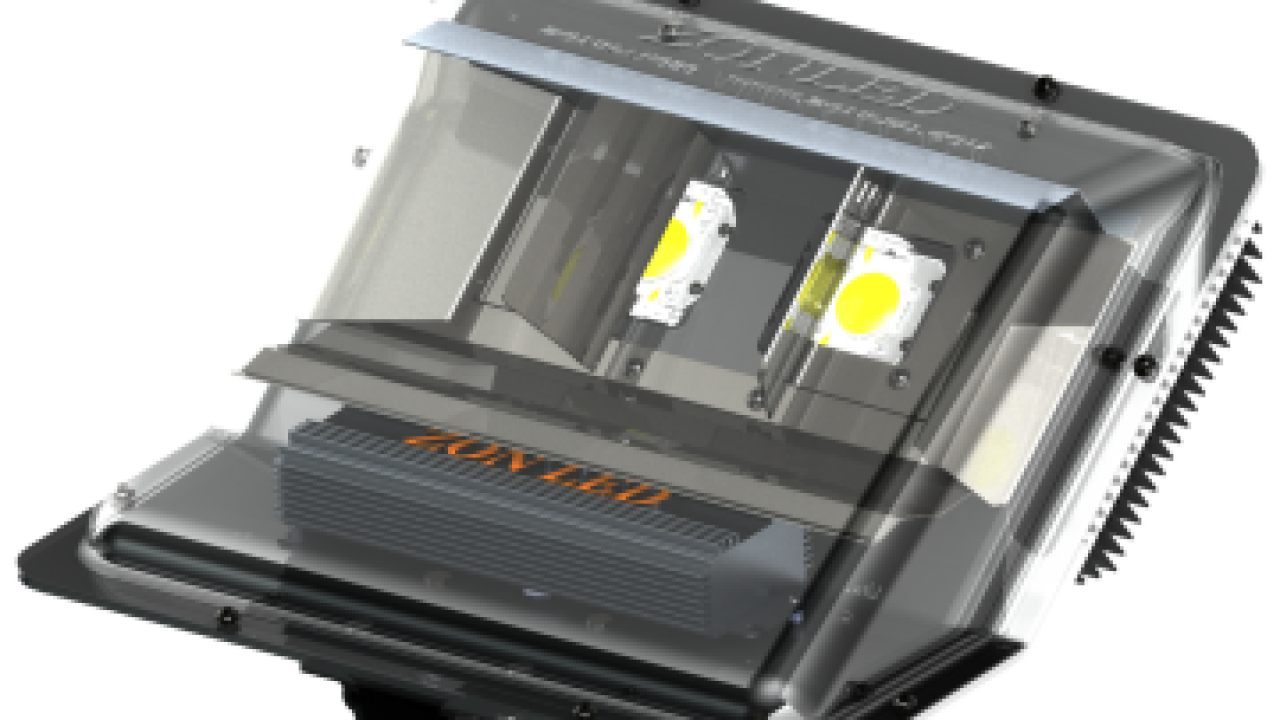
Industry lighting comparisons are normally made in photopic lumens: a measure of how much light a fixture emits, weighted by the sensitivity of the cone receptors. That weighting has been questioned for years, because photopic lumens do not describe how the eye actually perceives light at the levels found in streets, yards and warehouses. Scotopic performance is the fuller account.
How the eye works
The retina is a light-sensitive membrane at the back of the eye containing two kinds of receptor: cones and rods. For a long time it was accepted that cones were responsible for day vision and rods for night vision, and the lighting industry accordingly measured performance against cone-activated vision alone.
Research sponsored by the US Department of Energy over the past decades showed instead that cones and rods are collectively responsible for perception, in proportions that shift with the lighting condition. Our perception of light is therefore not consistent with the instruments long used to measure output, and a scotopic figure — a multiplier applied to the photopic measurement — has to be used when comparing sources of different spectra.
What it means in practice
A standard HPS 400 HID fixture draws 460 watts and produces 32,000 photopic lumens, which by conventional measurement is a very powerful light. But its output is yellow to orange, concentrated in the low colour temperature range, so what the eye perceives amounts to about 19,840 lumens.
The ZONHB160 draws 166 watts and produces only 12,000 photopic lumens: on a lumens-per-watt basis the two look equally efficient. Its output, however, is a much wider white spectrum in the 7,500–8,500 K region, close to natural daylight, and its scotopic figure exceeds 23,000 lumens. The LED fixture therefore consumes 61% less energy while delivering around 18% more perceived light than the HID it replaces.
A second comparison
Conventional HPS 250
ZONHB100 replacement
Power consumption
300 W
105 W (65% reduction)
Photopic output
19,000 lm
7,500 lm
Scotopic output
under 12,000 lm
over 15,000 lm (25% increase)
This is the concept that governs any sensible replacement decision: matching photopic lumens one for one will massively over-specify an LED fixture, while matching scotopic lumens gives the wattage actually needed.